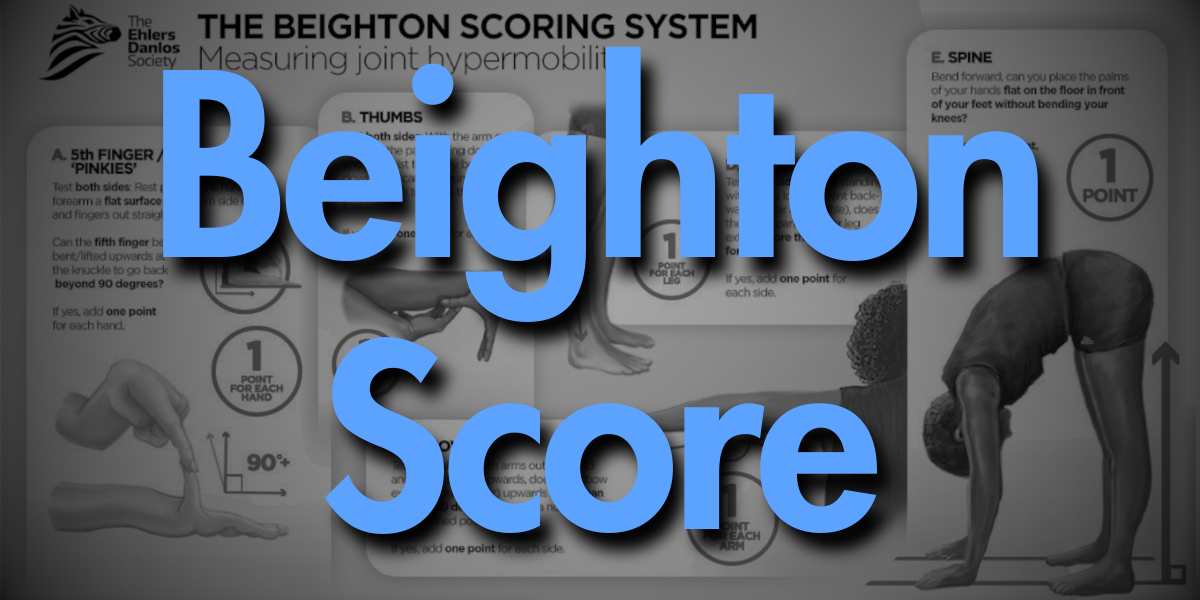
The Beighton Score is the most widely known assessment for generalised joint hypermobility, and is currently used as part of the 2017 hEDS Diagnostic Criteria.
This tool has a total score of 9, divided into the following joint movements:
- Pinky Hyperextension (>90 degrees) (1 point per side)
- Thumb to Volar Forearm (1 point per side)
- Elbow Hyperextension (>10 degrees) (1 point per side)
- Knee Hyperextension (>10 degrees) (1 point per side)
- Palms to Floor with Knees Extended
Different thresholds have been used across different settings, age groups, etc., but the most common thresholds, as seen in the hEDS Diagnostic Criteria are:
- 6/9 for pre-pubescent children and adolescents
- 5/9 for adults under 50
- 4/9 for adults over 50
Scoring at or above these levels classifies the individual as having ‘generalised joint hypermobility’.
Completing the Beighton Score
I would argue that the vast majority of the time, the Beighton Score is not completed strictly as written in the protocol as it is most often done in busy primary care and outpatient physiotherapy clinics where time is of the essence.
Most of the time, measurements are done by eye and independent of position. Given the lack of strict validation of the protocol (expanded upon below), I would argue this doesn’t really matter all that much.
However, for the sake of completeness I have included the written protocol of how to complete the test as it was originally intended:
History and Development of the Beighton Score
When you look into the history of development of the Beighton Score you will see that it is relatively fraught with a lack of robust justification or evidenced decision-making, carried forward by little more than academic inertia.
The development of the Beighton Score can be charted across three key papers in the 1960s and 70s.
Step 1. Carter and Wilkinson 1964
The first assessment tool vaguely resembling the Beighton Score saw publication in 1964, where Cedric Carter and John Wilkinson were investigating the claim that joint capsular laxity was implicated in the aetiology of congenital hip dysplasia.
In this investigation, they designed a tool to identify ‘generalised joint laxity’, to investigate its incidence in children with congenital hip dysplasia.
However, there was no justifcation outlined for any of the choices made in the development of this tool (most notably, the selection of joints, joint movements, range of motion cutoff thresholds measurement protocol).
The tool considered the following movements as demonstration of generalised capsular laxity:
- Passive apposition of the thumb to the volar surface of the forearm
- Ability to hyperextend the elbow more than 10 degrees
- Ability to hyperextend the knees more than 10 degrees
- Passive hyperextension of the wrist and all fingers, so that the fingers lie parallel with the extensor aspect of the forearm.
- An excess of passive dorsiflexion of the ankle and eversion of the foot
![[carterandwilkinson1.png]]
![[carterandwilkinson2.png]]
Generalised joint laxity was established to be present where 3 or more of these qualities were observed, so long as both upper and lower limbs were involved. The studied population was aged 5 to 11 years; a pattern you will see repeated in later research.
Step 2. Beighton and Horan 1969
By 1969, Peter Beighton – the namesake of the Beighton Score – and Frank Horan had adapted Carter and Wilkinson’s generalised joint hypermobility scoring tool as a way to describe the ‘orthopaedic aspects’ of 100 adults with Ehlers-Danlos syndrome. Interestingly, this paper was part of Peter Beighton’s thesis as part of his M.D. degree at the University of London.
The dorsiflexion + eversion test was replaced for the ‘palms to the floor with straight legs’ test we see in the modern version.
The simultaneous wrist/finger hyperextension to parallel with the extensor compartment of the forearm was replaced with the ‘90+ degree hyperextension of the little finger’ test we see in the modern version.
Again, no real justification was given for why these two tests were removed, nor for what made their replacements better. The only justification given for the use of this scoring tool overall was that it was ’easy to perform, and {provided} quantitative measurements’.
At the time the score was out of 5 rather than 9. The threshold chosen was 3 or more. Comparing this to the modern 9 scoring, this would relate to 5 or 6.
The most interesting finding from this study was that despite the studied cohort all having confirmed diagnoses of Ehlers-Danlos syndrome, only 63% of them passed this threshold.
Even at this time, it was known and documented in both papers that generalised joint hypermobility decreases with age as joints stiffen. This has been partially reflected in the differing thresholds per age group in the 2017 Criteria, but to what extent this is a sufficient accounting of the change to avoid disproportionately missing out later age cases is unclear.
Step 3. Beighton, Solomon and Soskolne, 1973
It is in this paper that the finalised Beighton Score as we know it today was published. While the same tests were performed in the 1969 paper, this paper seems to have mainly added the 0-9 scoring, rather than 0-5, wherein each limb gets its own full point for tests 1 through 4.
This paper again justified the content of the assessment tool for its ’ease’ of completion and its ability to produce quantitative results, making it effective for epidemiological screening.
Critiques and Limitations of the Beighton Score
In light of the history of its development, the face validity of the Beighton Score is not particularly robust. It was originally designed as an epidemiological screening tool whose formulation was based primarily around ease of use rather than any evidence-based idea of which joints are most commonly affected within clinical joint hypermobility.
One of the most salient critique’s of the Beighton Score that I have read so far is by Malek, Reinhold and Pearce in 2021. If you want to read their excellent paper, check it out here (link).
Otherwise, I’ll provide a brief summary of what I feel are the most impactful points made therein.
The absolute predominance of the Beighton Score across the globe in the clinical assessment of GJH is a puzzle, as the strength of evidence behind its use is disproportionately poor compared to its commonality of use.
- Choice of joints does not correlate well with joints most commonly affected in HSD/hEDS
- Threshold values are internationally debated, and poorly validated in different populations (e.g., athletic population vs general population)
- All-or-nothing scale, does not account for varying degrees of hypermobility
Commonly cited values for the sensitivity (true positive rate) and specificity (true negative rate) of the Beighton score are 78% and 99% respectively. However, this applies only directly to children aged 6-12, and only in comparison to
Realistic Use Case for the Beighton Score
Ultimately, despite the weaknesses and limitations of the Beighton Score as a tool for assessing generalised joint hypermobility, it is still a part of the hEDS Diagnostic criteria and so for now should continue to be used.
Among most people ‘in the know’, it is commonly accepted that the beighton score has arguably poor sensitivity (or in non-academic terminology; a high false negative rate) and so while it is a good tool to pick up hypermobile individuals, it is strictly not to be used to rule out generalised joint hypermobility.
The main problems of the beighton score in general practice is that most clinicians do not know to follow this nuance. I have personally spoken to multiple fellow clinicians throughout my time, who have proudly announced their ‘proving’ to a patient that they did not have HSD/hEDS due to the fact that they did not have a greater than 5/9 Beighton score, despite that patient reporting a number of clear clinical signs of suspicion for multi-system manifestation of connective tissue disorder.
For so long as the beighton score is accepted for its inability to ‘rule out’ GJH and thus hEDS/HSD, it is a fine and legitimate tool.